A strong WordPress Shopify integration is essential for brands that rely on WordPress for content and Shopify for commerce. Our development team evaluated the top integration methods to determine which approach offers the most flexibility, best performance, and strongest SEO foundation.
After analyzing both the Shopify plugin and ShopWP, our team recommends ShopWP as the superior integration method. Its architecture allows Shopify products to function as native WordPress content, giving developers far more control over design, SEO, and long-term scalability.
Table of Contents
The research on integrating Shopify with WordPress
Integrating Shopify with WordPress affects how your site is structured, how your content performs, and how efficiently users navigate between editorial pages and your store. The following sections outline the strategic considerations behind choosing WordPress vs Shopify and how Shopify plugins support hybrid setups.
WordPress vs Shopify: When a Hybrid Approach Makes Sense
WordPress and Shopify excel in different areas, which is why many businesses combine them. Shopify is engineered for high-performance eCommerce and offers fast checkout flows, secure payment processing, reliable product management, and strong storefront performance. WordPress remains unmatched for content marketing and SEO, providing flexible publishing tools and the ability to build rich editorial experiences.
Evaluate Shopify vs WordPress in our more in-depth article to determine which is right for your business.
Many brands choose a hybrid setup because:
- WordPress drives organic traffic: Its architecture, SEO tools, and content workflows outperform Shopify for long-form and content-heavy marketing strategies.
- Shopify outperforms for eCommerce: Shopify checkout, product management, and store performance consistently lead to higher conversion and fewer technical issues.
- Hybrid setups retain SEO equity: Businesses with years of ranking content avoid the risks of a full migration.
- Teams maximize existing skill sets: Most teams already know WordPress well and prefer enhancing their current site instead of rebuilding it.
This hybrid logic appears frequently in community discussions. Merchants often explain why they keep WordPress as the main site but use Shopify for commerce needs.
Community Shares why they stay in WordPress but sell on Shopify
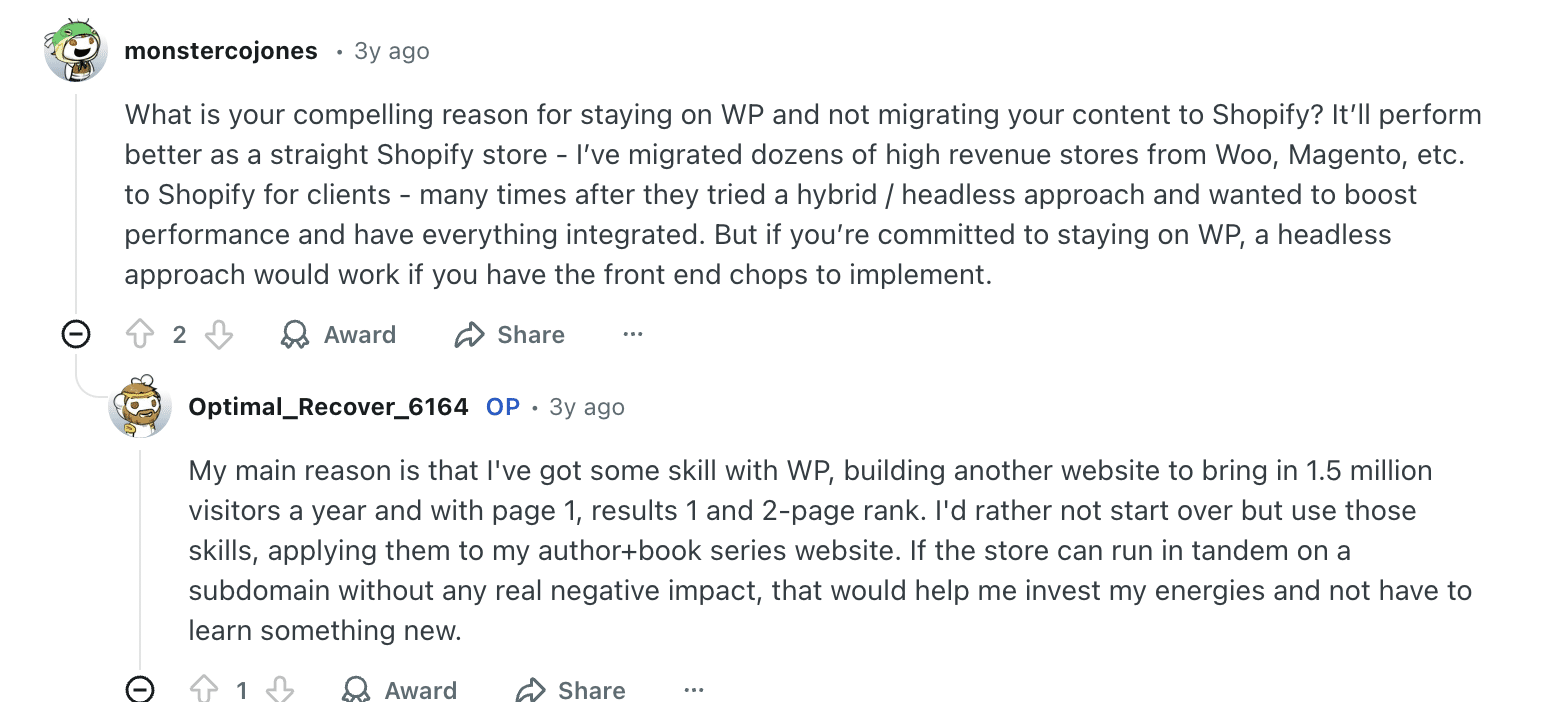
Check out the full Subreddit to see why many stay on WordPress but sell with Shopify »
For businesses that want both editorial depth and an enterprise-level commerce experience, a WordPress Shopify integration offers the strongest middle ground.
Shopify Plugins: When to Use Them and Why They Matter
Shopify plugins, often referred to as Apps, make it possible to extend Shopify functionality or integrate it with other systems. When connecting Shopify to WordPress, the plugin you choose determines your level of design control, product visibility, and SEO flexibility.
Shopify provides official documentation detailing how to embed commerce features into a WordPress site through their Sell on WordPress with Shopify app.
There are two primary integration paths:
- Shopify plugin: Ideal for simple sites that need a quick product embed or buy button. Customization and SEO control are limited, and much of the display relies on external Shopify assets.
- ShopWP: Imports Shopify products directly into WordPress as Custom Post Types. This allows theme-level control, stronger SEO performance, and a more native experience inside WordPress.
Understanding when to use Shopify plugins ensures your integration aligns with your content workflow, design system, and long-term goals.
The Core Architectural Difference
The most important difference between the Shopify plugin and ShopWP lies in how product data is handled inside WordPress.
| Feature | Shopify Native Plugin | ShopWP |
| Product Display | Embeds external Shopify widgets | Imports products as WordPress Custom Post Types |
| Content Status | Lives outside WordPress content system | Exists as true WordPress content |
| Design Control | Limited customization | Full control using WordPress templates |
| SEO Potential | Restricted and less indexable | Fully indexable with metadata control |
This difference influences design freedom, theme consistency, SEO potential, and long-term maintainability.
Why We Recommend ShopWP
Full Design Control With Native WordPress Templates
Because ShopWP treats products as native WordPress entries, developers gain complete creative control.
Advantages include:
- Theme consistency: Product pages match the site’s design without conflicting widget markup.
- Template hierarchy support: Create custom product layouts, archives, and loops.
- ACF compatibility: Add custom fields and build richer, more flexible product experiences.
- Clean markup: Developers control all HTML output for styling and responsive behavior.
This is not possible with Shopify’s plugin, which relies on predefined components and external styling.
Cleaner Development Workflows and Greater Extensibility
ShopWP integrates naturally with WordPress architecture.
This enables:
- Custom queries: Display products anywhere using WP_Query.
- Reusable components: Build and maintain consistent product modules across the site.
- Predictable maintenance: Fewer issues caused by external scripts or overrides.
- Hooks and filters: Modify product behavior using standard WordPress tools.
This creates a more sustainable long-term development environment.
Stronger SEO Through Native WordPress Content
Because ShopWP stores products inside the WordPress database, SEO teams maintain full control.
Key SEO benefits include:
- Editable metadata using RankMath or Yoast
- Improved crawlability because products live in the site structure
- Flexible internal linking across posts, product pages, and resources
- Custom schema markup for search enhancements
Since the Shopify plugin loads product content externally, it cannot offer comparable SEO precision.
Better Performance and a More Consistent UX
ShopWP avoids the performance issues that external Shopify widgets can create.
Results include:
- Faster load times: Fewer external assets reduce blocking scripts.
- Consistent styling: All design follows the WordPress theme.
- Predictable user experience: No mismatched UI patterns or iframe limitations.
This creates a smoother, more unified site experience.
When the Shopify Plugin May Still Be Enough
The Shopify plugin can work well for:
- Simple websites that need minimal product display
- Small catalogs
- Temporary storefronts
- Sites where Shopify is the primary platform and WordPress plays a limited role
For custom UX, stronger SEO, or strategic scalability, ShopWP remains the better choice.
Our Final Recommendation
Based on our evaluation of documentation, developer experience, design flexibility, and SEO performance, our team recommends ShopWP as the most effective method for WordPress Shopify integration. Its native handling of product data enables better design precision, stronger search performance, and cleaner development workflows.
Need a Custom WordPress and Shopify Integration?
If you are comparing WordPress vs Shopify or planning a hybrid strategy, our team can design an integration that preserves your SEO momentum while benefiting from Shopify’s powerful eCommerce tools.
Talk to RedTree about your integration project. We can unify your content and commerce in a way that supports long-term growth.
Don't Branch Out Alone
We know that your time is limited but taking your website to the next level is essential. Don’t branch out alone. Tap into our team of experts to keep your site ahead of the curve.
Let Us Help