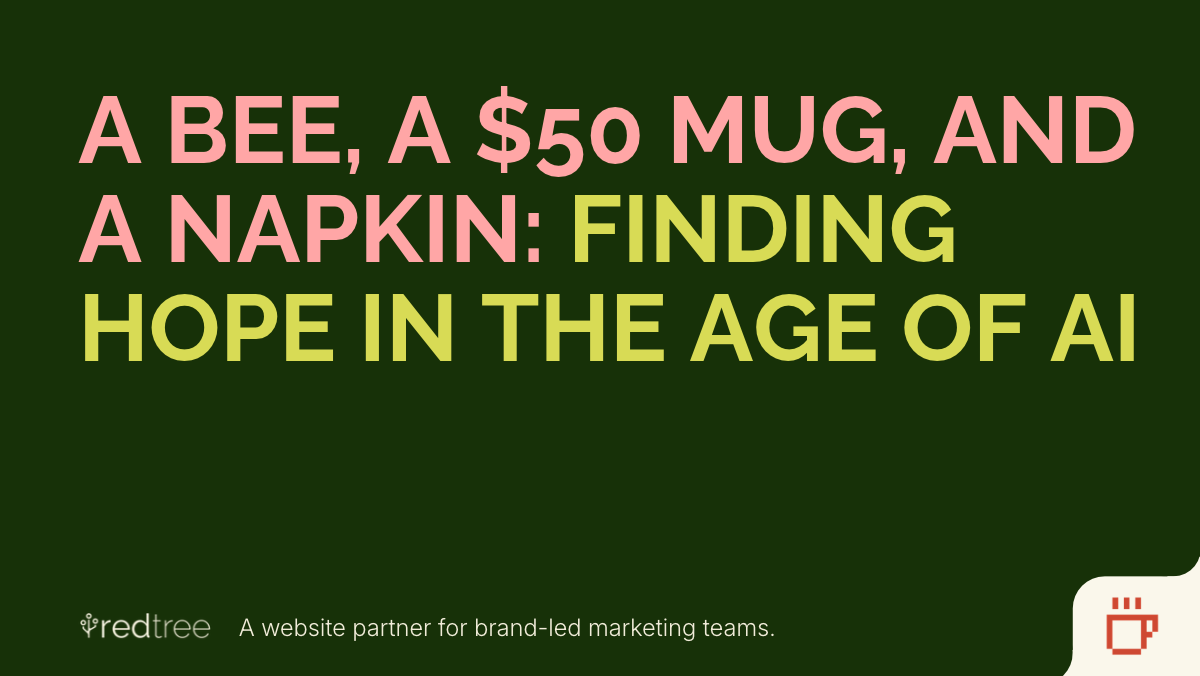
Some bees just go off and do their own thing. Those are the bees that save the hive!
A few weeks ago, Meesha and I attended the B2B Marketing Forum, and this idea stuck with me more than anything else I learned. I wrote it in my notebook, double-starred and underlined. Rory Sutherland, the behavioral science thinker and author of Alchemy, shared a story about bees while closing out the opening keynote, and in that moment, I felt seen by someone who didn’t even know I was in the crowd. It was one of those aha moments that lights you up and energizes you. I kept trying to explain it to people at the breaks, and Meesha didn’t even remember it when I brought it up later. But for me, it connected the dots between how I show up for my family, my team, and myself, and it gave me a clear view of how we as humans can approach the topic everyone at the conference was focused on: AI.
The bees that wander off
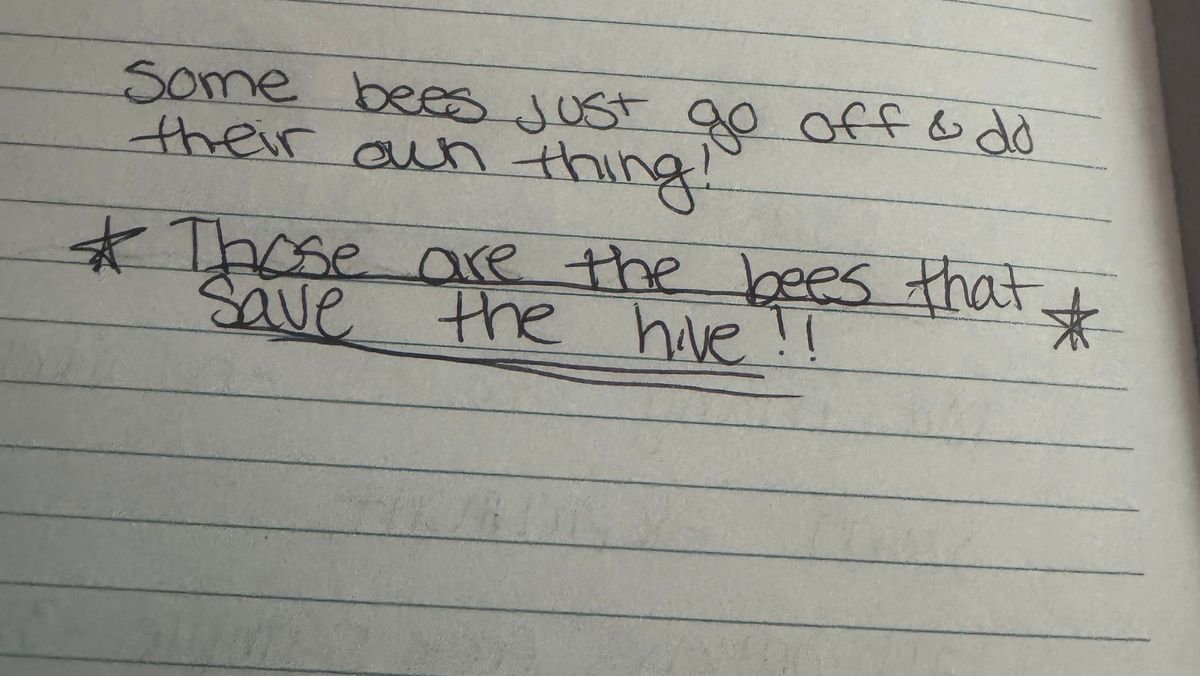
Here’s the gist. In a honeybee colony, most foragers rely on the waggle dance, a kind of directions-sharing dance other bees use to point the hive toward food. But a small share of foragers don’t follow the hive. They’re scouts, and they go looking for new food on their own while the rest of the hive works the spots already found. Scouts also search out new places for the colony to live. A study in Science found that scouts’ brains show gene activity similar to what’s linked to novelty-seeking in people. In other words, they’re wired to wander. And when the familiar flowers run out, they’re the ones who find what’s next.
The story of the bee hit hard because, as a creative person in a creative role, I often feel a tension between getting things done and creating something worthwhile. AI makes that tension worse, because it can create things that are objectively good, faster and cheaper. While I push for more time to think things through and add steps to our process, leaders everywhere are feeling the pressure to move faster and spend less, and if we can’t, AI will. I’ve also always been someone who thinks differently, and I know and love many neurodivergent people with complex minds. That’s not a small group. About 15 to 20% of people are estimated to be neurodivergent. Hearing that exact kind of thinking being recognized as valuable was healing in a lot of ways. It’s not a flaw. It’s an asset. And you can clearly see it in the natural world, a place we should all be looking to more for guidance, if I’m being honest.
More, but all the same
But we live in a tech world, and the truth is, I’ve struggled to reconcile the strength of AI with how it fits into our work. How can we compete as creatives? Can AI do the work better? And what does that mean for us as humans? We all need jobs, for one thing. And we need to be connected to one another, really connected, in ways a machine can’t replace. AI probably can do it, sometimes better, and always faster. So how do we show our value to leaders who, for better or worse, see faster and more as the top priority? It starts to feel a little hopeless. As a creative in a world with unlimited access to everything, it’s already a struggle to make something that hasn’t been seen or heard before. Now AI can pump it out faster than we can open a blank page, set up an easel, or open Figma. I’ve always believed in reaching the right person with the right message at the right time, and all of this has been rattling my values and the reasons I love this field.
The research backs up that unease, with a twist. In a 2024 study published in Science Advances, researchers from the University of Exeter and UCL split 300 participants into groups, some writing short stories with AI help and some without. Readers rated the AI-assisted stories as more creative and more enjoyable, and the boost was biggest for writers who weren’t naturally very creative. But the AI-assisted stories were also more similar to each other than stories written by people alone. Every story got better, but they all started to sound the same. The researchers called it a social dilemma. Each writer comes out ahead, but together they produce less variety. One detail stood out to me. The most naturally creative writers benefited the least from AI ideas, because AI mostly helped everyone else catch up. Which raises the question: if everyone can sound equally good, who’s still bringing something new?
Every shade of beige
So when I went to Robert Rose’s session, When Everyone’s a Thought Leader, Who Do You Trust?, I was given a little bit of hope. He named what I’d been feeling. He shared research showing 59% of senior buyers have received almost identical thought leadership from two different vendors. Not similar. Almost identical. He compared it to two people showing up to the same party in the same outfit. Everything, as one of his slides put it, is now available in every shade of beige. We have MORE and we have it FASTER but at what cost?
But that’s where the hope is. Humans crave novelty. When everything starts to look the same, we notice. We get bored, and we stop trusting it. It’s my hope that this is exactly why the creative minds and the sincere human work will be valued again.
It turns out AI is catching on too. In his session, AI-Forward, Not AI-Foolish, Wil Reynolds of Seer Interactive showed how early AI search believed whatever brands told it, so scaled content and self-promoting ‘best of’ lists won. Now AI tools are starting to weigh what they read and decide whether to believe it, even warning users that vendor rankings are self-serving. In data he shared, 70% of the time a brand’s listicle was cited, AI used it to recommend a competitor instead. His takeaway: being seen isn’t the same as being believed, and winning hearts and minds is how you’ll win AI.
The $2 mug and the $50 mug
About a week after the conference, Meesha brought up a handcrafted mug during one of our sales calls, after reflecting on the pressure we’d been feeling from clients. It was beautiful: high quality, with a cool design and a pottery glaze that made it one of a kind. It cost $50. She said people aren’t going to spend $50 on a mug when they can run to Target and get one for $2 in 15 minutes.
She’s right. But she’s also wrong.
When you just need a mug to drink your coffee, yes, you’ll buy the $2 one. But there are plenty of reasons to buy the $50 mug. You want something special. You want to support art and things made by hand, and the artist who made them. It’s a gift. It holds a memory. You just like nice things. And it’ll probably outlast the $2 one, because it’s better made.
That’s how I’ve started to think about AI in our work. Some work is the $2 mug. It just needs to exist and do its job, and AI is a great fit for that. Other work is the $50 mug. It needs to mean something, and that’s where human thinking and skill should come first.
It was good on the napkin
Through all of this, I keep thinking about Don Draper, because I’ve been rewatching Mad Men (a little shamefully, but I’m not stopping). He had plenty of flaws, but he wrote good copy, no questions asked. He thought, and thought, and thought until the right idea came to him. Sometimes it showed up scribbled on a napkin before it was ever typed. And it was good even on the napkin.
The napkin wasn’t what made it good. Neither was the typewriter. Robert Rose made a similar point in his session: nobody in 1987 put ‘Typed on an IBM Selectric’ at the bottom of a white paper. Audiences have never built trust on process or tools. It doesn’t matter how the work is made. It matters that it’s good.
That applies to AI too. AI is a tool, like the napkin and the typewriter. It can absolutely help make good work. But the good part, the concept that actually means something, comes from the thinking behind it. When a person with a real point of view is leading, the tool doesn’t matter much. The problem starts when the tool replaces the thinking instead of serving it.
And good thinking takes time. It takes trusting the people who know their craft and letting them work through the problem until the right answer comes, not the fastest one.
What it’s costing people
But I’m also nervous. In a world that can be overly focused on winning and efficiency, sometimes at the expense of effectiveness and correctness, I worry good, quality work will get abandoned. That we’ll end up discounting the color bees bring to the world and start embracing a beige world instead.
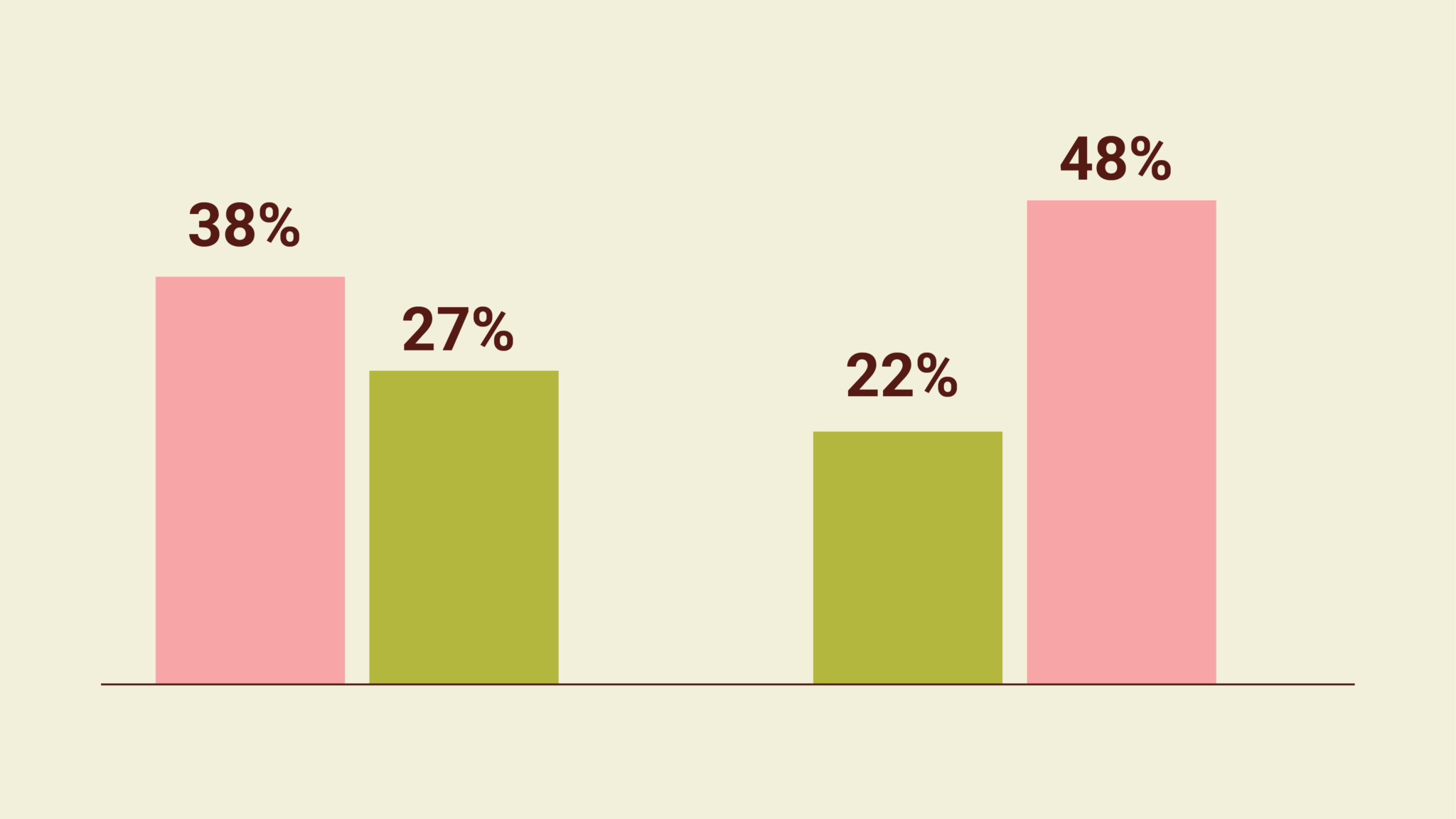
Some of that cost is already showing up in people. AI was supposed to take over the mundane tasks, or the ones humans just aren’t very good at. Instead, in a lot of places, it’s replacing people, so a team becomes one person who is expected to do it all, leaning on AI to fill in the gaps. And the people feeling it most aren’t always the ones making the decisions. Research Robert Rose shared from the Content Marketing Institute shows a perception gap. Leaders are the most likely to see efficiency gains from AI (38%) and the least likely to see burnout (27%). For individual contributors, it flips: only 22% see efficiency gains, while 48% see burnout. Same company, same tools, very different seat.
There’s a quieter cost too. Experienced marketers know what good looks like because they spent years making things the slow way. One topic that came up over and over again at the conference was about the young people coming up now, who may never get the chance to build that instinct. Kathleen Booth put it well in a quote Wil Reynolds shared: the more you lean on AI, the less qualified you become to judge its output. If we stop practicing the thinking, we lose the ability to tell good from beige.
How the human leads
So where does that leave us? I keep coming back to another line from my notes: the question isn’t how AI fits in. It’s how the human leads.
AI has its role. But it’s only the human on the other side of it who can give it the prompt, the data, the feelings, and the considerations that make the work actually good. That takes people who think differently, ask questions, and take their time. It takes the bees who wander off.
So here’s what I’d ask of anyone reading this, especially leaders. Think about the long-term effects of using AI the wrong way. Decide where human thinking and skill need to come first, and protect the people who do that work. And where it counts, slow down. Give your team room to make the $50 mug.
Because the hive doesn’t survive on the bees who strictly follow the rules of the hive. It survives on the ones who go looking for what’s next.
Don't Branch Out Alone
We know that your time is limited but taking your website to the next level is essential. Don’t branch out alone. Tap into our team of experts to keep your site ahead of the curve.
Let Us Help

